
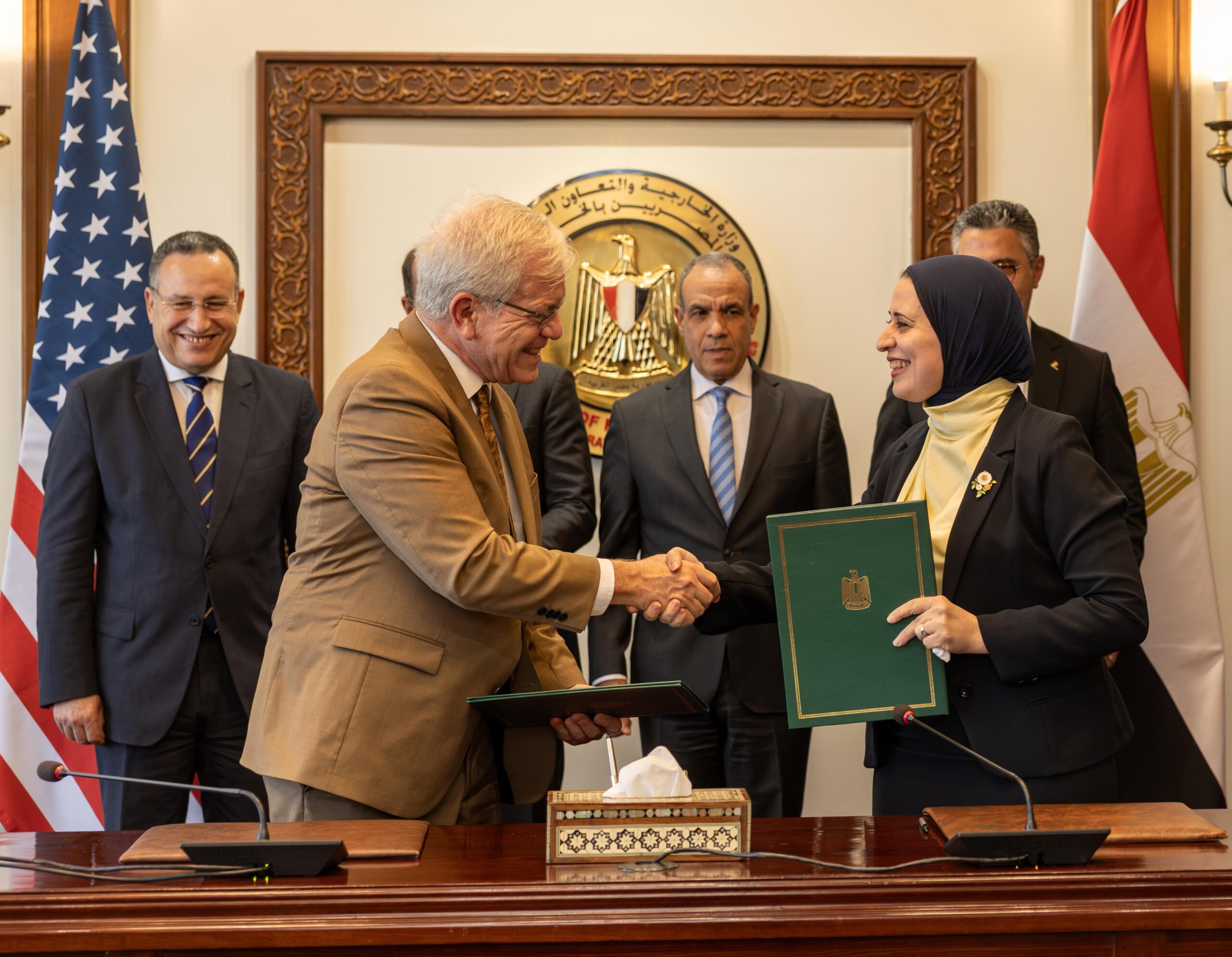
The United States and Egypt have signed their first-ever bilateral Strategic Objective Agreement for Advancing Mutual Prosperity, committing $125 million in U.S. funding to expand opportunities for American companies in Egypt, support private-sector growth in both countries, and strengthen economic cooperation between Cairo and Washington.
The agreement was announced in the New Administrative Capital on November 4, 2026, by U.S. Embassy Chargé d’Affaires Robert Silverman and Egyptian Foreign Minister Badr Abdelatty.
The signing ceremony, held at the Ministry of Foreign Affairs, was attended by Minister of Finance Ahmed Kouchouk, Minister of Supply and Internal Trade Sherif Farouk, and Minister of Higher Education and Scientific Research Abdel Aziz Qonsowa.
$125 Million in U.S. Funding to Support Egypt’s Economy
Under the agreement, the United States will provide $125 million in funding aimed at expanding opportunities for American businesses operating in Egypt, promoting private-sector growth in both countries, and supporting Egypt’s economic modernization efforts.
The agreement reflects a shared commitment to strengthening the U.S.-Egypt economic partnership and expanding investment opportunities across key sectors of the Egyptian economy.
Robert Silverman: Agreement Will Drive Economic Growth and Expand Opportunities for U.S. Companies
U.S. Embassy Chargé d’Affaires Robert Silverman highlighted the importance of the new agreement in advancing economic cooperation between the two countries.
Speaking during the signing ceremony at the Ministry of Foreign Affairs, Silverman expressed his pride in finalizing the agreement alongside Foreign Minister Badr Abdelatty and Deputy Foreign Minister Samar El Ahdal.
He emphasized that the agreement would generate significant economic growth in Egypt and expand opportunities for American companies across several strategic sectors.
These sectors include agricultural development, food security, basic and higher education, healthcare, Super Intelligence, water security and innovation, as well as workforce development.
Samar El Ahdal: Agreement Will Strengthen the U.S.-Egypt Partnership
For her part, Dr. Samar El Ahdal, Deputy Minister of Foreign Affairs for International Cooperation, expressed confidence that relations between Egypt and the United States would continue to develop and prosper under the new agreement.
She also highlighted her commitment to continuing joint efforts in the coming period to strengthen the partnership between the two countries and advance shared objectives toward mutual prosperity.
What Are the Main Objectives of the U.S.-Egypt Strategic Agreement?
The agreement marks the first Strategic Objective Agreement between the United States and Egypt, reflecting the strength of their bilateral partnership and their shared commitment to economic prosperity.
Under the agreement, both countries will work together to leverage Egypt’s strategic economic advantages, including:
-
Strategic geographic location: Expanding trade and investment opportunities.
-
Large workforce: Supporting workforce development and economic growth.
-
Growing markets: Creating new opportunities for American businesses.
-
Economic modernization: Supporting Egypt’s economic development efforts.
-
Private-sector growth: Strengthening the role of private businesses in both economies.
-
Investment opportunities: Expanding the presence and opportunities of American companies in Egypt.
These priorities aim to strengthen economic cooperation and maximize the benefits of Egypt’s competitive advantages.
Agreement to Promote Egyptian Self-Reliance and Private-Sector Growth
Beyond expanding investment opportunities for American companies, the agreement seeks to promote Egypt’s reliance on its own capabilities and resources while supporting broader economic modernization efforts.
It also aims to ensure that U.S. foreign assistance programs are implemented with maximum impact, efficiency, and accountability.
The agreement represents another step in strengthening the longstanding U.S.-Egypt partnership, expanding economic cooperation, and creating new opportunities for investment and private-sector development in both countries.