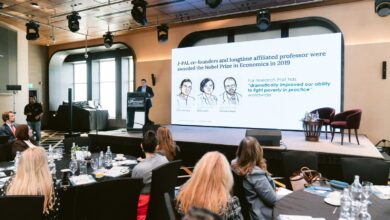

As development needs continue to rise while available resources face growing pressure, the Sawiris Foundation and the Abdul Latif Jameel Poverty Action Lab Middle East and North Africa (J-PAL MENA) at the American University in Cairo (AUC) brought together leaders from the private and banking sectors, development and donor organizations, researchers, and development experts to explore how evidence can help direct social investments toward interventions capable of delivering meaningful and sustainable impact.
The discussion took place during the “Evidence-Driven Impact” convening, which examined how research evidence, impact evaluation, and results measurement can be integrated into social investment decisions. The objective was to enable companies, banks, and donor organizations to allocate resources more effectively and support development programs with measurable and lasting outcomes.
Moving Beyond Social Spending to Measuring Real Impact
Discussions emphasized the importance of moving beyond traditional measures of social investment, such as the amount of funding deployed or the number of beneficiaries reached.
Instead, participants highlighted the need to focus on the actual change achieved, the sustainability of that change, and the efficiency with which resources are used.
The discussions also explored how partnerships between the private sector, development organizations, research institutions, and government entities can combine funding, expertise, and knowledge to test scalable solutions and expand their reach.
Sawiris Foundation Highlights Evidence-Based Development
During the convening, the Sawiris Foundation shared its experience in using research, evaluation, evidence, and continuous learning to strengthen its development programs.
The Foundation explained how evidence helps it reassess interventions that do not achieve their expected results while expanding approaches that demonstrate effectiveness.
Bab Amal Program as an Evidence-Driven Model
The Foundation highlighted its Bab Amal Program as a practical example of its evidence-driven approach.
The program combines economic and social support, livelihood development, and intensive household follow-up, while using research and evaluation findings to continuously refine its model.
To date, Bab Amal has reached approximately 14,000 families and contributed to a three- to fourfold increase in the value of household assets after 40 months. The experience demonstrates how evidence and data can contribute to stronger program design, more effective implementation, and sustainable development impact.
Government and Private Sector Leaders Join the Discussion
The convening brought together representatives from a range of institutions and sectors.
Representatives from Egypt’s Ministry of Social Solidarity included Engy El Yamany, Executive Director of the Rural and Environmental Industries Support Fund (REIS), and Reem Abdel Latif, Monitoring and Evaluation Consultant for the Takaful and Karama Cash Transfer Program.
Their participation reflected the diverse institutional expertise contributing to discussions on how social investments can be directed toward interventions that are more effective and measurable.
Business Leaders Discuss the Future of Social Investment
The event also featured an open panel discussion bringing together perspectives from the private sector and civil society.
The panel included:
- Mariam Allam, Founder and Board Member of the Essam & May Allam Foundation for Sustainable Development.
- Shams Owais, Government Relations and Partnerships Director for North Africa, the Levant and Türkiye at Mars.
- Nahla Mokhtar Agour, Corporate Affairs, Engagement & Sustainability Director at L’Oréal Egypt.
- Manal Hassan, Group Chief Sustainability Officer at Elsewedy Electric.
The discussion drew on their experiences in using resources, partnerships, and institutional knowledge to generate more effective social and development impact.
J-PAL MENA Highlights the Role of Research and Evaluation
J-PAL MENA presented research and evaluations covering different development sectors, demonstrating how global and regional evidence can support institutional decision-making.
The sessions focused on bridging the gap between research and implementation and translating research findings into practical tools that organizations can use to design development programs and guide social investment decisions.
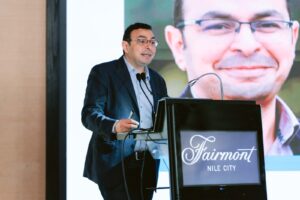
Dr. Ahmed Elsayed, Executive Director of J-PAL Middle East and North Africa, emphasized the importance of using scientific evidence to determine whether social programs are actually delivering meaningful results.
He explained that J-PAL MENA’s impact evaluations rely on rigorous scientific methodologies, particularly randomized controlled trials, to assess not only whether a program works, but also why it works, for whom, and at what cost.
Partnerships Can Help Scale Development Impact
Laila Hosny, Executive Director of the Sawiris Foundation, emphasized that growing development needs and limited resources make it increasingly important to direct funding toward interventions that demonstrate effectiveness.
She noted that the Foundation integrates evidence and measurement into its decision-making process to identify successful approaches, determine what needs improvement, and assess where scaling can generate greater impact.
Hosny also highlighted the importance of partnerships in bringing together complementary capabilities and expertise, including implementation experience, research, financing, technology, and the ability to scale successful interventions.
Practical Steps Toward Evidence-Driven Investment
The convening concluded with a discussion of practical measures that institutions can adopt to integrate evidence more systematically into decision-making.
These steps include defining the problem before selecting an intervention, reviewing existing research and previous experience, establishing clear outcome indicators, learning from implementation, and applying lessons learned to future decisions.
The “Evidence-Driven Impact” convening is part of the ongoing collaboration between the Sawiris Foundation and J-PAL MENA to strengthen the use of research and evaluation in development practice, bridge the gap between knowledge and implementation, and help institutions direct resources toward interventions that are more effective, measurable, and scalable.

About Sawiris Foundation
The Sawiris Foundation is one of Egypt’s first philanthropic development foundations. Established in 2001 with funding from the Sawiris family, the Foundation supports innovative development solutions aimed at reducing multidimensional poverty and expanding opportunities for underserved individuals and communities.
Its work spans education, economic and social empowerment, and quality-of-life improvement, in addition to supporting Egypt’s cultural and artistic landscape.
Over the past 25 years, the Foundation has developed extensive institutional experience in designing, funding, and scaling development models in partnership with government institutions, the private sector, civil society, and international organizations, with a particular focus on underserved communities, especially in Upper Egypt.
About J-PAL MENA at the American University in Cairo
The Abdul Latif Jameel Poverty Action Lab Middle East and North Africa (J-PAL MENA) at the Onsi Sawiris School of Business at the American University in Cairo is a regional office established in July 2020 as part of J-PAL’s global network of research centers.
J-PAL works to reduce poverty by ensuring that policymaking is informed by scientific evidence. Its global network includes more than 411 affiliated professors from leading universities worldwide and focuses on generating and synthesizing evidence from randomized evaluations to address key development and poverty-related challenges.
J-PAL also works with governments, nongovernmental organizations, donors, and other stakeholders to share knowledge, scale effective programs, and strengthen evidence-informed decision-making.
The Abdul Latif Jameel Poverty Action Lab was founded at the Massachusetts Institute of Technology (MIT) in 2003 and now has regional offices across Africa, Europe, Latin America and the Caribbean, the Middle East and North Africa, North America, South Asia, and Southeast Asia.
About the American University in Cairo
Founded in 1919, the American University in Cairo (AUC) is a leading U.S.-accredited, English-language institution of higher education and a center of intellectual, social, and cultural life in the Arab world.
AUC serves as a bridge between East and West, connecting Egypt and the region with the global community through research, partnerships with academic and research institutions, and study-abroad programs.
The university offers 40 undergraduate programs, 52 master’s programs, and two doctoral programs, built around a liberal arts education that encourages critical thinking and creative approaches to regional and global challenges.
AUC is accredited in both Egypt and the United States and operates as an independent, nonprofit, politically nonpartisan, nonsectarian, and equal-opportunity institution.