
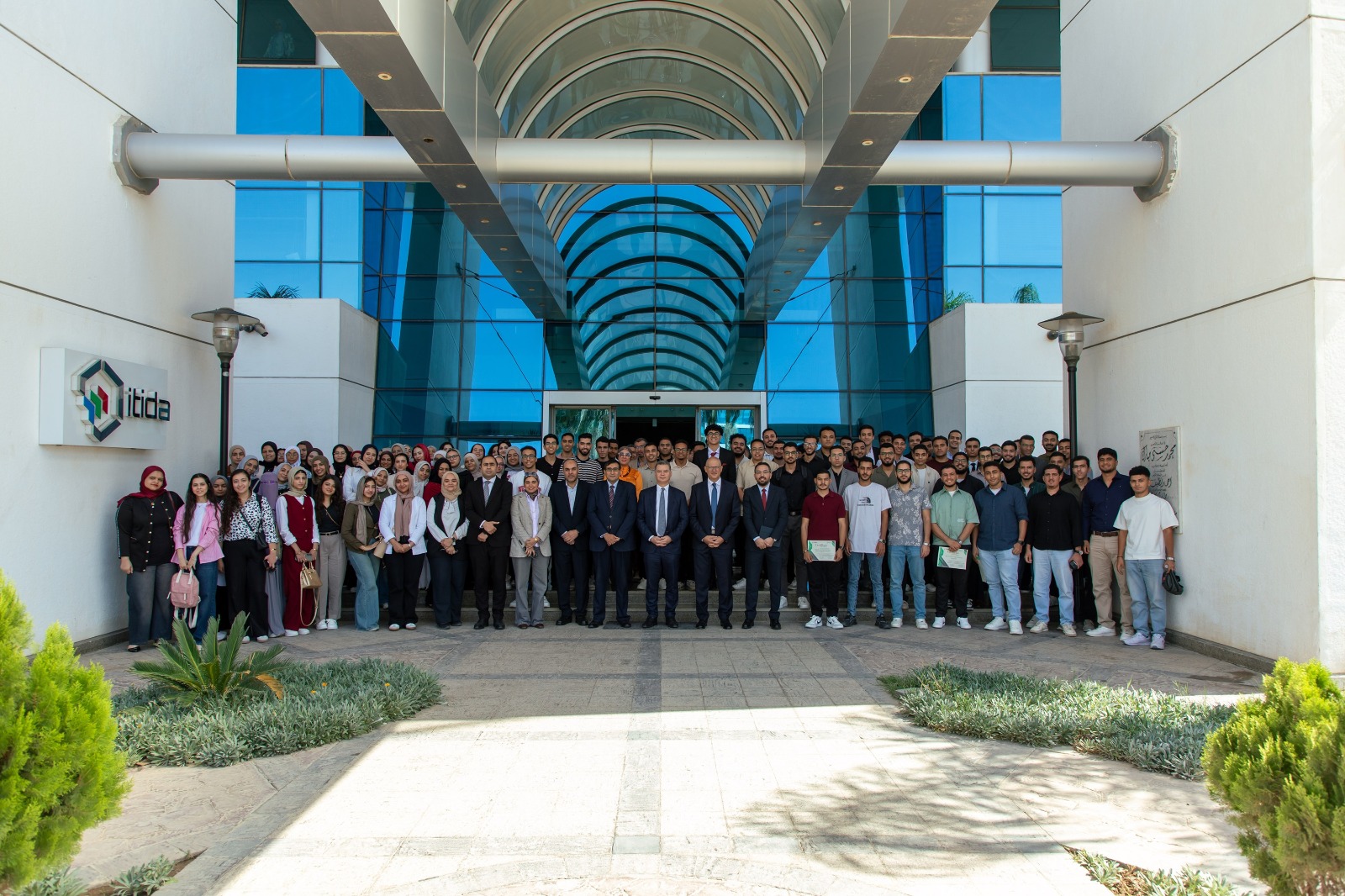
The Information Technology Industry Development Agency (ITIDA) and the National Telecommunication Institute (NTI) have honored the top-performing graduates of the 2026 Summer Training Program, following the participation of 10,485 university students from across Egypt.
The ceremony, held at ITIDA’s headquarters in Smart Village, celebrated students who completed a program designed to strengthen digital skills, provide practical technology training, and prepare young talent for the evolving demands of the information and communications technology (ICT) job market.
Implemented in collaboration with the Ministry of Communications and Information Technology (MCIT), the program supports Egypt’s broader efforts to develop its digital talent pool. It combines specialized technical instruction with professional development, soft skills, workplace readiness, and freelancing capabilities to help university students build the competencies needed to succeed in a rapidly changing technology industry.
The ceremony was attended by Eng. Ahmed El Zaher, CEO of ITIDA; Prof. Dr. Ahmed Khattab, President of NTI; and Eng. Mahmoud Sofrata, ITIDA’s Vice President for ICT Markets Development, alongside senior officials from both institutions.

ITIDA Highlights Digital Skills Development as a Driver of Egypt’s ICT Growth
Eng. Ahmed El Zaher, CEO of ITIDA, emphasized that investing in young people and developing their digital skills are essential to the growth and global competitiveness of Egypt’s technology industry. He underscored the importance of high-quality training programs that bridge the gap between theoretical knowledge and practical application.
El Zaher noted that rapid technological advances, particularly in artificial intelligence (AI), are transforming the nature of work and reshaping the skills employers require. Continuous learning, adaptability, and ongoing professional development are therefore increasingly important for young people seeking to benefit from emerging career opportunities.
He added that equipping students with relevant technology skills early in their academic journeys gives them a strong foundation for long-term professional growth and helps them adapt to changing labor market requirements.
According to El Zaher, the Summer Training Program, implemented in partnership with NTI, is Egypt’s largest summer training initiative for university students in terms of participant numbers. Beyond its scale, the program prioritizes training quality and a comprehensive learning experience, combining specialized technical instruction with soft skills, workplace readiness, and freelancing training.
This integrated approach aims to strengthen students’ technical and professional competencies and improve their readiness to enter the ICT workforce.
The program also accommodates different levels of experience and learning needs. Participants can continue in the same technology track in subsequent years and advance to more specialized levels, or explore other technology disciplines to broaden their knowledge and identify potential career paths.
Approximately 1,200 trainees completed their initial training pathways and progressed to advanced levels, highlighting the program’s emphasis on continued learning and skills development.
El Zaher reaffirmed ITIDA’s commitment to expanding access to specialized technology training across Egypt. He explained that developing qualified talent in governorates beyond Cairo complements the agency’s efforts to encourage local and international companies to expand their operations nationwide.
By aligning talent development with companies’ demand for specialized skills, these efforts can help regional locations attract investment and support the expansion of Egypt’s ICT industry.
He added that the program’s diverse technology tracks reflect ITIDA’s commitment to keeping pace with technological developments and helping young people acquire relevant skills across multiple fields, opening pathways to promising professional careers.

NTI Strengthens Practical Training and International Certification Opportunities
Prof. Dr. Ahmed Khattab, Director of NTI, congratulated the more than 10,000 students who completed the 2026 Summer Training Program, noting that graduates met the program’s requirements by either developing a practical project published on GitHub or obtaining a certification through an international academy.
He expressed his wishes for their success in their academic and professional journeys, emphasizing that the skills acquired through the program represent an important step toward building successful careers in the ICT sector.
Now in its second consecutive year, the program is being delivered in partnership with ITIDA as part of MCIT’s strategy to develop digital capabilities and prepare specialized talent to meet the evolving needs of Egypt’s technology industry and the international market.
The 2026 edition introduced an important enhancement by requiring participants to complete a practical graduation project to receive the program completion certificate. It also strengthened opportunities for students to pursue international certifications and develop freelancing skills.
Demand for the program was strong, with more than 40,000 students applying within less than seven days of registration opening, reflecting the growing interest among Egyptian university students in acquiring technology skills and improving their career prospects.
The program also demonstrated an early economic impact. According to Khattab, the top 200 graduates generated approximately $25,000 in total freelancing revenue within a short period after completing their training, averaging around $125 per graduate.
Khattab thanked the teams, trainers, and coordinators at NTI and ITIDA for their efforts in delivering the program. He reaffirmed the institutions’ commitment to continuing their collaboration to improve training content, strengthen young people’s capabilities, and prepare graduates to compete in the ICT sector.

Hands-On Technology Training Connects Students with Industry
Practical learning was a key component of the 2026 Summer Training Program. As part of this approach, top-performing students visited the offices of international and local technology companies in Smart Village to gain firsthand exposure to professional work environments and business operations.
The visits introduced students to different technology roles, workplace practices, and the technical and professional skills required by employers. Participating companies included VOIS, Valeo, Systems Egypt, Coretech Innovations, Esperti Solutions, and Izam Inc.
The visits gave students an opportunity to explore career paths in information technology and telecommunications and develop a clearer understanding of workplace expectations.
Eng. Mahmoud Sofrata, ITIDA’s Vice President for ICT Markets Development, welcomed the successful conclusion of the program, describing it as one of Egypt’s key summer training initiatives.
He explained that the program allows students to demonstrate their abilities through graduation projects, earn specialized professional certifications, and gain practical experience in freelancing, helping them strengthen their employability and prepare for the job market.
Sofrata also praised participants for dedicating their time to learning and developing new skills. He emphasized that commitment, adaptability, and continuous learning are qualities valued by employers and fundamental to long-term professional success.
ITIDA and NTI Summer Training Program 2026: Key Figures and Results
The 2026 Summer Training Program reached 10,485 university students across all 27 governorates, reflecting ITIDA and NTI’s commitment to expanding access to digital skills training nationwide.
Training opportunities were distributed geographically with the aim of achieving balance in line with student numbers in the targeted academic disciplines in each governorate.
The regional distribution of participants was as follows:
- Greater Cairo: 3,691 trainees
- Lower Egypt and the Delta: 3,941 trainees
- Upper Egypt: 2,298 trainees
- Canal governorates: 555 trainees
The program offered eight technology training tracks comprising more than 26 courses across a range of specialized disciplines. The curriculum was designed to help students develop practical competencies aligned with the needs of the ICT industry.
Cybersecurity and Artificial Intelligence Lead the Technology Training Tracks
Cybersecurity attracted the largest number of participants, followed by artificial intelligence and software development. The distribution across the eight technology tracks was as follows:
- Cybersecurity: 2,192 trainees
- Artificial intelligence: 2,001 trainees
- Software development: 1,998 trainees
- Data science: 1,827 trainees
- Digital arts: 745 trainees
- Systems administration: 617 trainees
- Cloud computing: 559 trainees
- Electronics: 548 trainees
The range of disciplines reflects the program’s focus on developing digital talent across multiple technology fields and preparing students for evolving industry requirements.
120 Hours of Technical and Professional Skills Training
Each participant received 120 hours of training, comprising 90 hours of specialized technical instruction and 30 hours dedicated to soft skills or freelancing.
This structure combines technical learning with professional development, helping students apply their knowledge, improve workplace readiness, and translate their training into potential employment, independent work, and entrepreneurship opportunities.
Male students accounted for 58% of participants, while female students represented 42%, demonstrating broad participation in digital skills development.

3,807 Students Enroll in International Technology Academy Programs
As part of the program’s international training component, 3,807 students enrolled in training programs delivered through academies affiliated with leading global technology companies.
Participating academies included Amazon Web Services (AWS), Cisco, Fortinet, Huawei, and Red Hat. Their training curricula provide students with specialized knowledge and technical skills aligned with the standards and learning frameworks of these international technology providers.
The closing ceremony recognized the program’s highest-performing participants. Awards were presented to students who achieved top results, including 44 students who earned the Fortinet Cybersecurity certification.
The ceremony also recognized students who secured freelancing opportunities, known as Gigs, and the teams behind the program’s three best graduation projects.
These achievements highlight the program’s focus on practical outcomes, professional certification, and the development of skills that can support students’ transition from university education to the workforce.
Freelancing and Career Readiness Strengthen Graduate Employment Prospects
Beyond technical training, the program emphasizes freelancing and professional skills as pathways for students to gain practical experience and access income-generating opportunities.
The approximately $25,000 generated by the top 200 graduates through freelancing illustrates the potential for students to apply their newly acquired skills in real-world projects shortly after completing their training.
Combined with practical graduation projects, international certification opportunities, and exposure to technology companies, these elements help students develop a broader range of competencies relevant to employment, independent work, and entrepreneurship.
The program’s integrated model reflects the growing importance of combining technical expertise with communication, adaptability, problem-solving, and professional readiness in a competitive ICT job market.

Developing Egypt’s Digital Talent to Support ICT Growth and Investment
The 2026 Summer Training Program forms part of MCIT’s broader efforts to develop a new generation of specialists in emerging technologies and expand Egypt’s digital talent pool across all governorates.
Through collaboration between ITIDA and NTI, the initiative combines technical education, hands-on training, international academy curricula, and freelancing skills to help young Egyptians prepare for changing labor market demands.
By developing qualified talent nationwide and strengthening links between students and industry, the program supports the growth of Egypt’s information and communications technology sector, encourages investment beyond major urban centers, and reinforces the country’s ambition to become a regional and global hub for technology services and service exports.