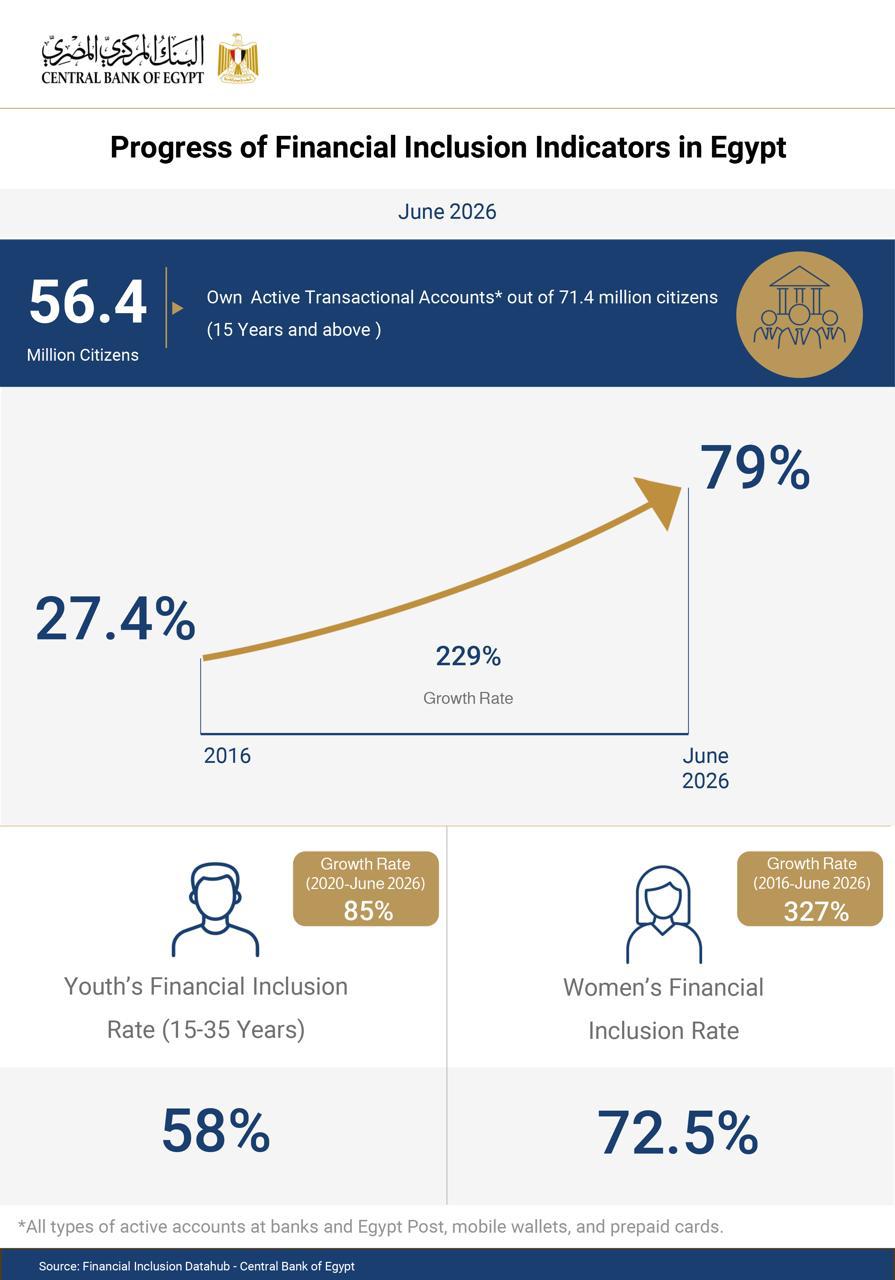
Financial Inclusion in Egypt has achieved a major milestone, reaching 79% by the end of June 2026, according to the latest financial inclusion indicators issued by the Central Bank of Egypt (CBE).
The achievement reflects years of coordinated efforts by the Central Bank of Egypt and the Egyptian financial sector to expand access to banking and financial services, promote digital payment solutions, and encourage citizens to participate in the formal financial system.
According to the latest figures, 56.4 million citizens now have active financial accounts that enable them to conduct financial transactions, out of a total of 71.4 million citizens aged 15 years and above.
This remarkable increase demonstrates Egypt’s continued progress in creating a more inclusive financial environment where individuals, families, and businesses can access secure and reliable financial solutions.
Financial inclusion has become a key pillar of Egypt’s economic development plans, as it supports financial stability, encourages entrepreneurship, improves savings habits, and strengthens participation in the formal economy.
Millions of Egyptians Gain Access to Financial Services
The growth of Financial Inclusion in Egypt has been supported by expanding the range of financial products available to citizens.
Active financial accounts include:
Bank accounts
Postal accounts
Mobile wallets
Prepaid cards
These services allow citizens to complete financial transactions more easily, receive payments securely, and access modern financial solutions without depending only on traditional cash transactions.
The Central Bank of Egypt has focused on making financial services available to different segments of society, including individuals in rural areas, women, youth, and small business owners.
Through policies, awareness campaigns, and cooperation with financial institutions, Egypt has worked to remove barriers that previously limited access to formal financial services.
The increase in account ownership reflects a transformation in citizens’ relationship with the financial sector, as more people now use banking and digital payment tools in their daily lives.
Women and Youth Lead Financial Inclusion Expansion
One of the most important achievements in Egypt’s financial inclusion progress is the significant improvement among women and young citizens.
The financial inclusion rate among women increased from 19.1% in 2016 to 72.5% by June 2026.
This represents a growth rate of 327%, showing the effectiveness of programs designed to increase women’s participation in financial activities.
Women-focused financial inclusion initiatives have contributed to:
Expanding access to banking services
Supporting female entrepreneurs
Increasing financial awareness
Promoting economic independence
Encouraging participation in formal financial channels
These efforts support Egypt’s broader goals of empowering women economically and ensuring equal opportunities in accessing financial services.
Youth Financial Inclusion Continues Strong Expansion
Young citizens have also recorded significant progress in financial participation.
The financial inclusion rate among citizens aged 15 to 35 years increased from 36.3% in 2020 to 58% in June 2026, representing an increase of 85%.
This growth reflects the success of programs designed to introduce young people to digital banking services, electronic payments, and modern financial products.
Increasing youth access to financial services helps create a generation that is more connected to the digital economy and better prepared to manage financial opportunities.
Financial Inclusion Strategy 2022-2025 Delivers Strong Results
The improvement in financial inclusion indicators reflects the successful implementation of Egypt’s Financial Inclusion Strategy (2022-2025).
The strategy was developed through cooperation between the Central Bank of Egypt, government ministries, and relevant authorities to create a comprehensive framework for expanding financial access.
The strategy focused on increasing the availability and usage of financial services while improving financial awareness among citizens.
According to the Financial Inclusion Datahub indicators issued by the Central Bank of Egypt, ownership and usage of financial services recorded significant growth, increasing by 229% between 2016 and June 2026.
The strategy contributed to several key objectives, including:
Expanding access to financial products
Increasing digital financial transactions
Supporting underserved communities
Improving financial education
Encouraging wider participation in the formal economy
These achievements highlight the importance of coordinated national efforts in building a stronger and more inclusive financial sector.
National Initiatives Supporting Financial Inclusion in Egypt
The progress achieved in Financial Inclusion in Egypt has been supported by several national initiatives implemented through cooperation between the Central Bank of Egypt, government institutions, and development partners.
Haya Karima Presidential Initiative
The “Decent Life” (Haya Karima) initiative has played an important role in improving access to essential services in rural communities.
The initiative has helped expand financial access among citizens who previously had limited connection with formal financial institutions.
By supporting rural development and improving economic opportunities, Haya Karima contributes to broader financial inclusion objectives.
Supporting Smallholder Farmers and Rural Communities
The “Transforming the Livelihoods of Smallholder Farmers” project supports agricultural communities by improving access to financial tools and services.
The initiative aims to strengthen economic participation among farmers and provide better opportunities for sustainable growth.
Supporting Women and Youth Programs
Additional programs implemented in cooperation with the Ministry of Youth and Sports and the National Council for Women aim to increase financial awareness and encourage greater participation in the formal financial system.
These initiatives help citizens understand financial products and use them effectively.
Second National Financial Inclusion Strategy 2026-2030
Building on previous achievements, the Central Bank of Egypt is currently developing the Second National Financial Inclusion Strategy (2026-2030).
The new strategy adopts a broader vision that focuses not only on providing access to financial services but also on ensuring that these services are used effectively, safely, and sustainably.
The strategy aims to:
Increase the use of financial products
Support entrepreneurs and businesses
Integrate the informal economy into the formal sector
Improve the quality of financial services
Strengthen consumer protection
The new approach reflects the transition from simply increasing account ownership to improving the overall financial experience of citizens and businesses.
Measuring Financial Inclusion Through Data and Research
The development of the new strategy relies on detailed analysis and evidence-based research.
The framework measures financial inclusion through three main dimensions:
Access to financial services
Usage of financial products
Quality and effectiveness of services
The Central Bank of Egypt has also used findings from a financial services demand-side survey conducted with technical support from the World Bank and the International Finance Corporation (IFC).
The survey was implemented in cooperation with the Central Agency for Public Mobilization and Statistics (CAPMAS) during the first quarter of 2026.
The research helps identify:
Challenges preventing citizens from using financial services
Existing gaps in financial access
Policies needed to improve participation
This data-driven approach allows policymakers to develop solutions based on real market needs.
Digital Transformation and Sustainable Finance Drive Future Growth
The future of Financial Inclusion in Egypt will depend heavily on digital transformation, innovation, and sustainable finance.
The upcoming strategy focuses on expanding:
Digital payment technologies
Mobile banking solutions
Financial technology services
Secure electronic transactions
The strategy also supports Egypt’s transition toward a green economy by encouraging sustainable finance tools that promote responsible investment and economic development.
Financial education programs will continue to play an important role by helping citizens understand financial products and make informed decisions.
Supporting SMEs and Strengthening the Financial Sector
Supporting small and medium-sized enterprises (SMEs) remains one of the main priorities of Egypt’s financial inclusion plans.
Improved access to financial services enables businesses and entrepreneurs to:
Obtain suitable financing solutions
Expand their activities
Create employment opportunities
Contribute to economic growth
The Central Bank of Egypt also works to strengthen public-private partnerships and improve financial infrastructure to support long-term economic sustainability.
Egypt’s Financial Inclusion Journey Continues
The continued growth of Financial Inclusion in Egypt represents a significant achievement in expanding financial access and connecting more citizens with formal financial institutions.
With 56.4 million citizens now holding active financial accounts, Egypt continues to move toward a more inclusive, digital, and sustainable financial system.
The next phase will focus on ensuring that financial services are not only available but also used effectively, securely, and responsibly by individuals, entrepreneurs, and businesses across the country.