Ericsson Mobility Report highlights the Middle East and North Africa (MENA) as one of the world’s fastest-growing 5G markets, forecasting that regional 5G subscriptions will increase from 80 million today to 370 million by 2031, as operators continue expanding network coverage and deploying advanced capabilities.
Global 5G Subscriptions Surpass Three Billion
According to the report, 162 million new 5G subscriptions were added worldwide during the first quarter of 2026, pushing the global total to 3.1 billion subscriptions.
Ericsson expects this figure to more than double over the next five years, reaching 6.4 billion 5G subscriptions by the end of 2031, reflecting the accelerating global adoption of next-generation mobile connectivity.
To date, nearly 390 communications service providers have launched commercial 5G services, while demand for 5G Standalone (SA) capabilities and network slicing continues to grow, enabling operators to deliver more differentiated and advanced connectivity services.
MENA Emerges as a High-Growth 5G Market
The report identifies the Middle East and North Africa (MENA) as one of the strongest growth regions for 5G adoption.
The region currently has approximately 750 million mobile subscriptions, including 80 million 5G subscriptions, up from 60 million a year earlier, representing an annual growth rate of 33%.
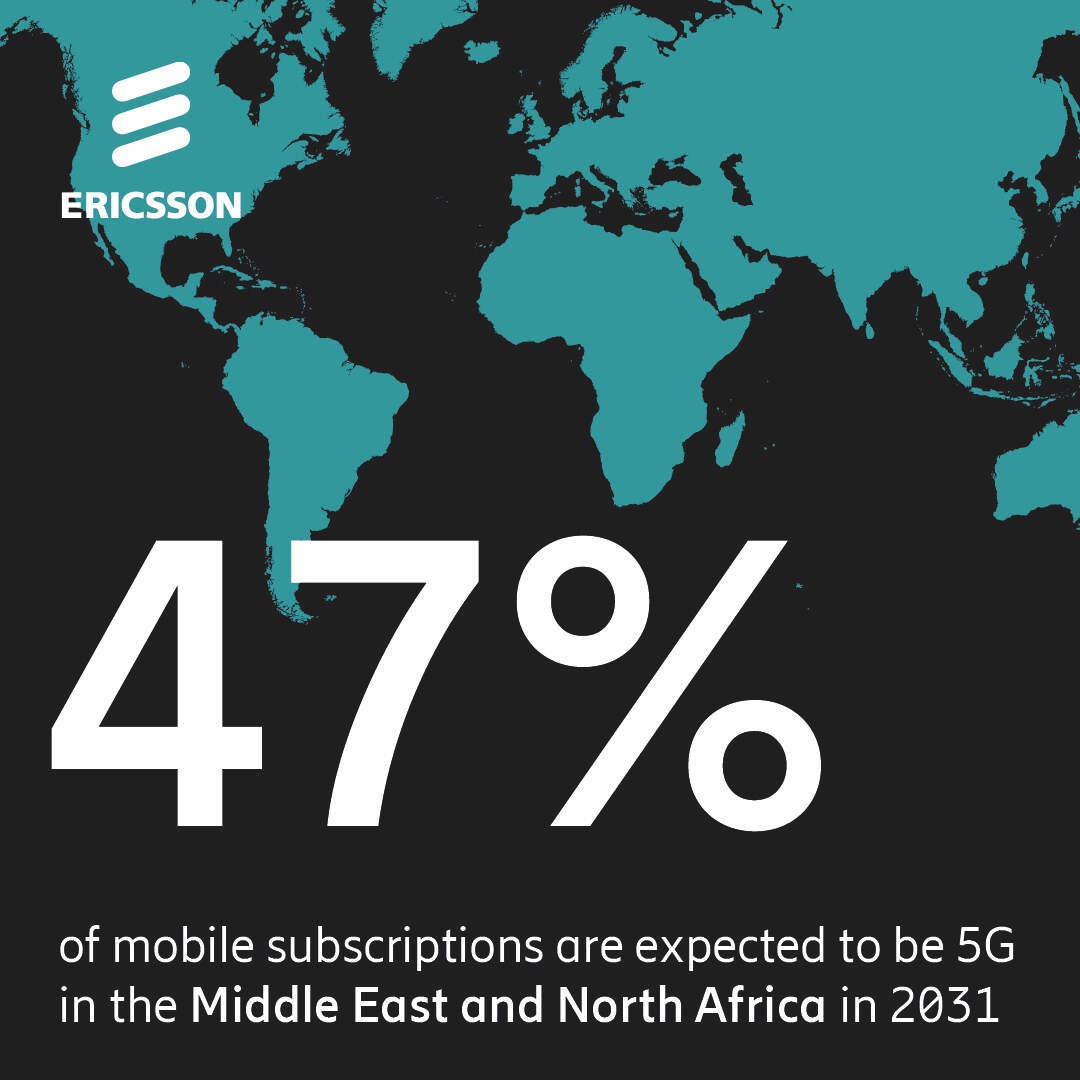
Although 5G penetration currently stands at 11%, Ericsson expects substantial room for expansion as operators continue investing in wider coverage and more advanced network capabilities.
By 2031, the number of 5G subscriptions in MENA is forecast to exceed 370 million, representing more than a fourfold increase from current levels.
Mobile Data Traffic to Triple by 2031
Ericsson projects that mobile data traffic across MENA will nearly triple over the next five years, increasing from 11 exabytes to 30 exabytes per month.
At the same time, the average smartphone user is expected to consume 47 GB of mobile data per month, driven by the rapid adoption of AI-powered applications, Extended Reality (XR) experiences, and an increasingly connected and autonomous digital ecosystem.
Ericsson: Mobile Networks Are Becoming the Foundation of the Digital Economy
Commenting on the report, Kevin Murphy, President of North Middle East at Ericsson, said the region’s connectivity landscape is evolving at an unprecedented pace.
“Mobile networks across MENA are no longer simply enabling communication—they are becoming the foundation upon which people, businesses, and entire economies will build their digital future,” Murphy said.
He added that as demand for more intelligent and immersive connectivity continues to grow, the region’s telecommunications infrastructure is well positioned to support digital transformation and accelerate innovation across industries.
June 2026 Ericsson Mobility Report Highlights
The June 2026 edition of the Ericsson Mobility Report also features several in-depth analyses and industry case studies, including:
- The rapid growth of differentiated connectivity offerings from communications service providers worldwide.
- The increasing importance of uplink traffic in AI-driven mobile networks.
- The critical role of mobile connectivity in enabling AI-powered enterprise transformation.
- A joint article with Qualcomm examining the evolution of AI-enabled Extended Reality (XR), highlighting how smart glasses and next-generation wearable devices are creating new user interfaces that extend digital experiences beyond smartphones.
The report provides valuable insights into the future of mobile connectivity and the technologies expected to shape digital economies over the remainder of the decade.